40 Korean Abbreviations You Cannot Guess From the Parts
· 9 min read
Korean shortens phrases by taking the first syllable of each word and gluing them together. The result looks like an ordinary two-syllable word and means something you would never reconstruct from the pieces.
This is the vocabulary that comment sections assume you already know. Dictionaries mostly miss it, and subtitle translators usually replace it with whatever English phrase fits the timing.
Each entry below gives the Hangul, a romanization, what it actually means, and — where it helps — the longer phrase it was cut down from.
How the shortening works
The mechanism is almost always the same. Take a phrase of two or more words, keep the first syllable of each, and glue them together. 갑자기 분위기 싸해짐 becomes 갑분싸. Four words become three syllables.
That is why these words are unguessable. The result is phonologically ordinary — it looks and sounds like any other Korean noun — but its meaning lives in words that are no longer visible. A dictionary lookup of the surface form usually returns nothing, or worse, returns an unrelated homonym.
It also means the process is productive. New abbreviations appear constantly, built the same way, and Korean speakers parse them on first contact because they recognise the shape. Learning the mechanism is more durable than memorising any particular set.
One practical consequence: when you meet an unfamiliar two- or three-syllable word in a comment section and it is not in the dictionary, assume it is an abbreviation before you assume it is a typo. Working backwards from the syllables to a plausible phrase succeeds more often than you would expect.
Fandom basics — what fans call themselves and what they do
These are the words fans use about themselves and about the machinery of being a fan, and they are the ones you will meet first in comment sections. Most of them are compounds that shorten a longer phrase, which is why they look opaque until someone unpacks them.
There is a pattern worth noticing here. A large share of this vocabulary describes stages — entering a fandom, pausing, leaving, coming back — because fan identity is understood as something with a timeline rather than a fixed state.
The rest names the things fans actually do: the merch, the events, the chart pushes. Once you see the split, the individual words stop looking random and start looking like a vocabulary set for one shared experience.
These terms are also the safest to use. They are fan-to-fan words about fans, so there is very little risk of accidentally insulting anyone by using them in the wrong place.
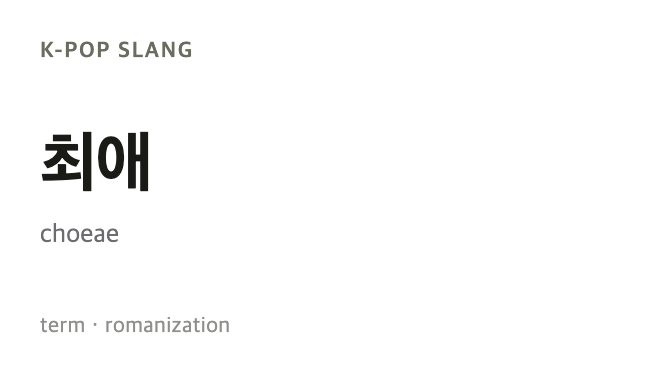
- 최애 (choeae) — your favourite member or group — what English-speaking fans call a bias. Literally: most loved.
- 입덕 (ipdeok) — the moment you become a fan of something. Literally: entering the fan world.
- 덕후 (deokhu) — an obsessive fan or enthusiast. Literally: the Korean reshaping of Japanese otaku.
- 덕통사고 (deoktongsago) — becoming a fan suddenly and against your own plans. Literally: fandom plus traffic accident.
- 응원법 (eungwonbeop) — the fixed fanchant for a song. Literally: the method of cheering.
- 응원봉 (eungwonbong) — a group's official lightstick. Literally: cheering stick.
- 굿즈 (gutjeu) — fan merchandise, official or not. Literally: goods.
- 떡밥회수 (tteokbap hoesu) — an earlier hint or plot thread finally being paid off. Literally: collecting the bait.
- 컴백 (keombaek) — a release cycle, not a return from absence. Literally: comeback.
- 아미 (ami) — the Korean spelling of ARMY, the BTS fandom name. Literally: ARMY.
Reactions — how fans describe being affected
Korean has a rich set of words for the specific feeling of being emotionally ambushed by content, and they show up constantly in reaction videos, live chats, and comment sections.
English tends to reach for the same few intensifiers no matter what happened. Korean distinguishes between the flutter of a sudden crush, the physical response of goosebumps, the collapse of composure after something absurd, and the flat exhaustion that arrives afterwards.
Each of those has its own word, and knowing which one a commenter reached for tells you what kind of moment they just had.
These are the words most worth learning early if your goal is to read comments rather than write them.
- 레전드 (rejendeu) — a moment or photo that people will still be posting years later. Literally: legend.
- 케미 (kemi) — the chemistry between two or more members. Literally: chemistry.
- 화이팅 (hwaiting) — you've got this — a cheer, despite looking like the English word fighting. Literally: fighting.
- 대박 (daebak) — wow — works for delight and for disaster. Literally: big hit.
- 심쿵 (simkung) — the jolt of your heart lurching at something. Literally: heart thump.
- 웃프다 (utpeuda) — funny and sad at the same time. Literally: funny plus sad.
- 킹받다 (king-bat-da) — the exaggerated, meme version of getting annoyed. Literally: king plus getting heated.
- 닭살 (daksal) — goosebumps, or the cringe you get from something too sappy. Literally: chicken skin.
- 레알 (real) — for real. Literally: real.
- 오글거리다 (ogeulgeorida) — so cringey your hands curl up. Literally: to curl up.
Abbreviations you cannot guess
Korean compounds aggressively, and the result is usually unguessable from the parts. Each entry below lists the phrase it was cut down from, which is the fastest way to make it stick.
The mechanism is almost always the same: take the first syllable of each word in a phrase and glue them together. That is why the short form looks like a normal two-syllable word while meaning something completely unrelated to either syllable on its own.
This also means the abbreviations are productive — new ones appear constantly, built the same way. Learning the mechanism is more useful long term than memorizing any particular set of them.
- 공방 (gongbang) — attending a music show recording as an audience member. Literally: short for open broadcast.
- 직캠 (jikcam) — a fancam that stays on one member for the whole song. Literally: camera pointed directly.
- 취켓팅 (chwiketting) — hunting for cancelled tickets after a sellout. Literally: cancellation plus ticketing.
- 첫콘 (cheotkon) — the first show of a multi-date run. Literally: first plus concert.
- 중콘 (jungkon) — a middle show of a multi-date run. Literally: middle plus concert.
- 막콘 (makkon) — the final show of a tour or a run of dates. Literally: last plus concert.
- 출첵 (chulchek) — the fan roll call before entry to a music show recording. Literally: short for attendance check.
- 포카 (poka) — a collectible photocard that comes inside an album. Literally: short for photocard.
- 생카 (saengka) — a cafe event fans throw for an idol's birthday. Literally: short for birthday cafe.
- ㅇㅈ (injeong) — agreed, that's right. Literally: the initial consonants of the word for acknowledge.
Everyday slang that shows up in variety shows
Unscripted content is where casual vocabulary actually lives. These terms rarely appear in textbooks and constantly appear on screen, usually as an on-screen caption emphasizing something a cast member just said.
Variety captions are worth treating as their own genre. Editors add them for comedic timing rather than for accuracy, so a caption may exaggerate, repeat, or spell out something the speaker only half-said. That makes them excellent vocabulary exposure and unreliable pronunciation exposure.
If you watch variety regularly, this section will pay off faster than any other on the page.
- 보라해 (borahae) — the BTS and ARMY promise to trust and love each other to the end. Literally: to purple you.
- 신기방기뿡뿡방기 (singibanggi ppungppungbanggi) — a SEVENTEEN catchphrase for something amazing, padded with nonsense rhyme. Literally: amazing plus nonsense rhyme.
- 무한아나스 (muhan anaseu) — the endless encore loop of Very Nice at a SEVENTEEN show. Literally: infinite Very Nice.
- 눈치 (nunchi) — the read-the-room sense —
눈치가 없다means someone does not have it. Literally: eye measure. - 맛집 (matjip) — a place worth eating at — also used figuratively, as in a group that is a stage
맛집. Literally: tasty house. - 만렙 (mallep) — someone who has maxed out at something. Literally: max level.
- 회식 (hoesik) — a company dinner your team is expected to attend. Literally: company meal.
- 선생님 (seonsaengnim) — teacher, with the honorific suffix attached. Literally: teacher.
- 동생 (dongsaeng) — someone younger than you, of either gender. Literally: younger sibling.
- 막내 (maknae) — the youngest member of a group. Literally: youngest.
Where these actually appear
Abbreviations cluster in written, informal Korean: comment sections, group chats, variety show captions, and the on-screen text that editors add for comic timing.
They are rarer in scripted drama dialogue, which is written to sound natural rather than to sound online. So if you are learning from dramas alone, this is precisely the vocabulary you are not being exposed to — and it is the vocabulary that fills the comments under every clip you watch.
Variety captions are the densest source. Editors add text for emphasis, and that text uses the fastest, most current form of the language available. A single episode can carry more current slang than a season of drama dialogue.
How to make these stick
Learn the long form first, then the short one. 갑분싸 is a random string until you have seen 갑자기 분위기 싸해짐 once; after that it is obvious and permanent.
Do not drill these in isolation. Their whole function is social — they mark the speaker as current and casual — so meeting them in a real comment does more than ten flashcard repetitions.
And treat recognition as the goal. Producing slang correctly requires a feel for how current it still is, and that feel takes far longer to build than the vocabulary itself. Understanding protects you; producing exposes you.
FAQ
Do Koreans actually use all of these? Most of them, yes, but not evenly. Fandom vocabulary lives online and in fan spaces rather than in everyday conversation, and a few entries are already fading. Where a term is losing currency the entry says so.
Can I use these when talking to an idol? Be careful. Words carrying a warning line are fine to understand and bad to produce, especially in a message an artist will read. Fan-to-fan slang is not automatically fan-to-artist slang.
Why are so many of these abbreviations? Korean compounds easily and Korean internet culture rewards brevity, so a four-syllable phrase gets cut to two almost immediately. Learning the full form first makes the short form obvious.
Will these help me understand variety shows? They will help with the captions, which is where most of this vocabulary appears on screen. Spoken variety Korean is fast and heavily contracted, which is a separate problem from vocabulary.
How do I tell an abbreviation from a normal word? You often cannot, from the surface alone. The reliable signal is failure: if a two- or three-syllable word returns nothing useful in a dictionary but is clearly being used casually, it is almost certainly a shortened phrase. Searching the word in Hangul plus 뜻 will usually surface an explanation written for Korean speakers.
Do these go out of date? Faster than any other part of the vocabulary. Some entries here have been stable for a decade; others arrived in the last two years and may not survive the next two. That is another reason to treat recognition as the goal — an aged-out abbreviation is harmless to understand and awkward to use.
Read next