The Word That Tells You Everything: Korean Titles as Plot
· 9 min read
There is a kind of scene that plays out in almost every Korean drama, and if you are watching with English subtitles you will miss it completely.
Two people have been circling each other for eight episodes. Nothing is declared. Then one of them stops using the other's title and says their name instead. The subtitle reads the same either way — a name is a name. But Korean audiences sit up, because the relationship just changed, and nobody said so out loud.
Korean does a lot of its storytelling in the space English subtitles cannot reach: what you call someone.
Why titles carry the weight
Korean prioritises the relationship over the individual. You rarely address an adult by bare name. You address them by their position relative to you — older brother, senior at work, teacher — and that choice announces the relationship every single time you open your mouth.
The Korea Herald, which runs an ongoing series on exactly this, puts it as titles doing "the storytelling that the script doesn't explain in detail." That is the mechanic. The script does not need a scene where someone says we are closer now, because the title already said it.
The ones you will meet first
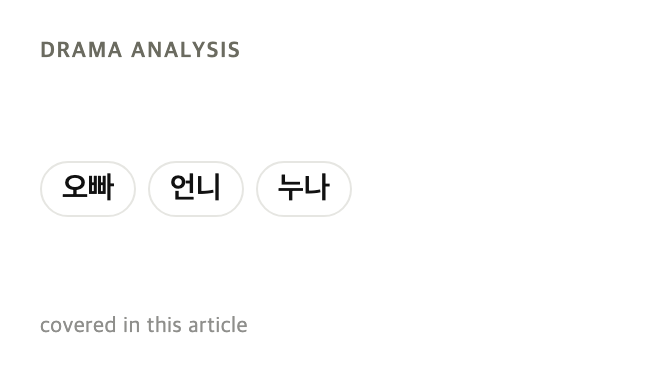
오빠 (oppa) — literally "older brother", used by a woman for an older man. It covers actual brothers, close friends and boyfriends. When a woman switches from a man's name to oppa, the temperature of the scene changes. Subtitles render it as the man's name, or drop it entirely.
언니 (eonni) — the same shape between women.
형 (hyeong) / 누나 (nuna) — the male-speaker equivalents. Hyeong is worth watching for: used outside a family it marks chosen family, and when a junior calls a workplace superior hyeong instead of a rank, the hierarchy in the room quietly drops away.
선배 (sunbae) / 후배 (hubae) — senior and junior, at school or at work. Not purely about age: someone younger than you can be your sunbae if they started earlier. Subtitles say "senior", which is accurate and carries none of the warmth.
–씨 (–ssi) — attached to a name, polite and deliberately neutral. This is the default between adults who are neither close nor hostile. When a drama lets a character finally drop it, that is a turning point. When a character goes back to it after a period of closeness, that is a breakup announced without a breakup scene.
–님 (–nim) — one step higher again. Safe to over-honour; you can always dial it down later.
아저씨 (ajeossi) / 아줌마 (ajumma) — middle-aged man and woman. These carry a generational charge. Ajumma can be affectionate and can sting, and Korean dramas use that double edge deliberately.
The bigger switch: 존댓말 → 반말
Underneath the titles sits the register itself. 존댓말 (jondaenmal) is polite speech; 반말 (banmal) is casual speech — literally "half speech".
Dramabeans, which has been recapping Korean drama since 2010, described the rule as: people who are the same age or older than you, and familiar with you, may use banmal. Getting there normally takes a tacit agreement — one person asks to "speak comfortably", and once formality is cut, it does not go back.
That is why the moment lands. Two people agreeing to drop 존댓말 is a small contract, and audiences read it the way English-language audiences read a first kiss.
It also runs the other way. A character can use 반말 they have not earned, at someone who outranks them, and it registers as an insult — not because of the words, but because of the entitlement. English has no clean equivalent, so subtitles simply render the sentence and the offence evaporates.
One structural detail that explains a lot
Here is the part that surprises most learners: in 존댓말 there is no comfortable way to say "you."
Polite Korean is built so that you refer to the person in the third person — by their title — rather than pointing at them. You do not say you to a teacher; you say Teacher. Only once you are in 반말 can you address someone directly.
So when characters finally reach 반말, they gain the ability to say you to each other for the first time. A confession in 존댓말 and the same confession in 반말 are not stylistic variants. One of them can point at the person; the other cannot.
How to actually notice this while watching
You do not need to understand the sentence. You need to catch one word.
- Listen for the ending, not the meaning. A sentence ending in –요 is polite. The same
sentence with the –요 shaved off is casual. That single syllable is the whole signal.
- Note what each character calls the other, once per episode. Write it down. When it
changes, something happened.
- Watch the direction. If one person drops formality and the other does not, that asymmetry
is the scene. Seniors can go casual downward; juniors cannot go casual upward.
Where the subtitles help and where they stop
English subtitles are good at plot and bad at register. They will tell you what happened. They will not tell you that the speaker just claimed a closeness they had not been given, or gave up one they had.
That gap is fixable while you watch. Our extension puts the romanization under every Korean subtitle line and marks the speech level of each line, so the switch shows up as a badge instead of something you have to already know Korean to catch. You can try the reading half of it right now on any line you paste into the pronunciation tool, and the titles above all have their own entries in our Korean vocabulary.
The office is where you see it fastest
Workplace dramas are the clearest classroom for this, because an office gives everyone a rank and then forces them to talk anyway.
Watch what happens around a table. A team lead addresses a junior in 반말 without asking. The junior answers in 존댓말 and will do so for the entire series. Nobody comments on it, because nobody needs to — the asymmetry is the org chart, spoken aloud, in every exchange.
Then the drama breaks it on purpose. A junior uses 반말 upward in an argument, or a senior keeps using 존댓말 with someone they outrank, and the room goes quiet. The first is insubordination. The second is colder than insubordination: it is a senior refusing the closeness that their rank entitles them to offer.
Drinking scenes exist partly to move these lines. Alcohol is where Korean colleagues renegotiate formality, which is why so much plot happens over a table. A relationship that shifted at dinner is a relationship that shifts in speech the next morning.
Family words used on strangers
The first thing that confuses learners is that Korean family titles are not restricted to family. Oppa, eonni, hyeong and nuna all get used on people you are not related to.
This is not sloppiness. It is the language doing what it always does: refusing to leave a relationship unnamed. If you are close to someone older, you need a word for that closeness, and Korean reaches for the family shelf.
The consequence is that these words are load-bearing in a way English cannot copy. When a woman in a drama chooses hyeong for an older man instead of oppa, she is not making a mistake. She is filing the relationship under friendship rather than romance, and she is doing it in one syllable, in front of everyone, without saying anything anyone could argue with.
The same move exists in reverse. A character can start using oppa on a man they have called by name for years, and the audience knows what it means before the character admits it.
What this means for the way you watch
None of this requires fluency. It requires knowing that the signal exists.
A viewer who knows nothing about Korean sees two people talking. A viewer who knows about titles and register sees the same two people negotiating distance in real time — and sees it several scenes before the plot makes it explicit.
That is the actual reward here. Not vocabulary. Earlier access to the story.
FAQ
Is it rude if I use the wrong title? Between learners and Korean friends, almost never — the effort reads as effort. The risk is using a title that claims a closeness you have not been offered, especially oppa or banmal with someone you have just met. When in doubt, add –씨 and stay polite. It is easy to move closer later and awkward to move back.
Why do subtitles delete these words? Because English has nowhere to put them. There is no natural English for "older male friend I am close to but not related to". Subtitlers either drop the title or replace it with a name, which keeps the sentence readable and loses the relationship information.
Can I just learn the titles and skip the grammar? For watching, yes — knowing the titles and hearing the –요 ending will carry you a surprisingly long way. For speaking, no. The register decision touches every verb you produce, so it stops being a vocabulary question the moment you open your mouth.
Does 반말 mean the same thing as being rude? No. 반말 between people who have agreed to it is warmth, not rudeness. It becomes rude only when one side takes it without it being offered. The words are identical; the entitlement is what changes.
Do these rules still hold with younger Koreans? The rules are loosening, particularly among people in their twenties and in online spaces, but they have not gone away. Dramas often exaggerate the strictness for dramatic effect — which, conveniently, makes them easier to learn from than real life.
Where can I practise hearing the difference? Any scene with a clear senior and junior. Variety shows are unusually good for it because the relationships are real and the captions are generous. Paste any line you catch into the pronunciation tool to see how it actually sounds versus how it is spelled.
Sources
- The Korea Herald, "From 'oppa' to 'ajumma': How honorifics shape K-drama" (2 November 2025)
- The Korea Herald, "When 'oppa' becomes '-ssi': linguistic markers of K-drama" (16 December 2025)
- Dramabeans, "Glossary: Banmal" (13 July 2010)
Read next