What English Subtitles Delete: A Korean Speech-Level Reading of One Netflix Trailer
· 11 min read
The show is number seven on Netflix's global TV Top 10 this week, in its seventh week on the list, charting in thirty-three countries. English-speaking viewers know it as Agent Kim Reactivated. Korean viewers know it as 김부장 — gimbujang.
That difference is not a translation quirk. It is the first thing English subtitles delete, and it happens before a single line of dialogue is spoken.
부장 (bujang) is a rank: department head, roughly a middle manager with a team under him. Calling a man 김부장 rather than by his given name is a complete social statement in three syllables. It says he is addressed by function, that the people around him are below or above that function, and that nobody in the room is going to speak to him the way they would speak to a friend.
An English title cannot carry that, so it substituted a genre promise instead. This article is about the same deletion happening line by line, inside the dialogue, where it costs you much more.
Why speech level is the information you are actually missing
Most guides to learning Korean from video are vocabulary guides. They hand you a word list from a show and count that as the lesson.
The trouble is that vocabulary is the part English subtitles already give you. If a character says 딸 and the subtitle says "daughter," nothing was lost. You did not need a blog post for that.
What the subtitle cannot give you is speech level — the grammatical choice, made fresh in every single Korean sentence, of how the speaker ranks themselves against the person they are talking to. English has no slot for it. There is no place in "Are you going to sit and watch?" to put the information that the speaker just claimed seniority.
So it gets dropped. Not badly translated — dropped, because there is nowhere to put it. Every English subtitle you have ever read for a Korean show has been silently discarding this, on every line, for the entire runtime.
The material: five lines from one official trailer
Everything below comes from the sixty-second official trailer, which Netflix publishes for free as promotional material. Two subtitle tracks were read at the same timecodes: the Korean subtitle track, and the English subtitle burned into the video.
Five lines are quoted, each under fifteen syllables, each with its timecode. Nothing from the episodes themselves is quoted, and no continuous passage is reconstructed. The reason for the ceiling is at the end of the article.
Romanization and the bracketed pronunciation in each entry are generated by the same engine that powers the extension, not typed by hand.
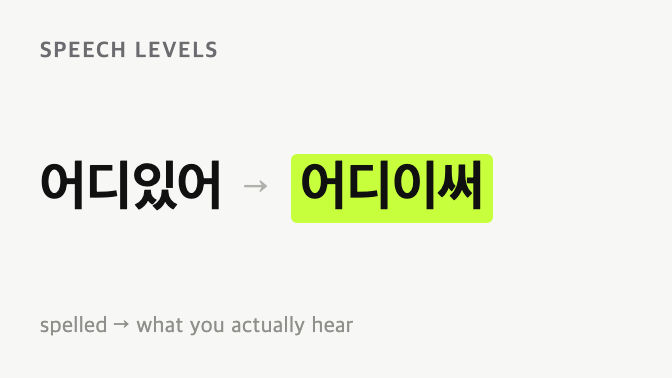
Line 1 — 어디있어 (0:01)
어디있어 · eodiisseo · spoken [어디이써] — Agent Kim Reactivated, official trailer, 0:01
Netflix's English subtitle for that line reads "Where is she?"
The English asks about a specific person. The Korean does not mention one.
There is no "she" in 어디있어, and no "you," and no subject of any kind. The sentence is a verb stem plus one ending. Korean drops anything the situation already supplies, and the translator had to invent "she" because an English sentence cannot stand up without a subject.
The ending is 어, and 어 is 해체 (haeche) — the plainest casual level, what learners usually meet as 반말 (banmal). Two syllables of grammar, and you already know the speaker is not being careful with whoever they are asking.
Line 2 — where the "please" actually lives
Two lines later, someone asks Kim to give up whatever he used to be and raise his daughter.
이제 모든 걸 다 잊고 · ije modeun geol da itgo · spoken [이제 모든 걸 다 읻꼬] — official trailer, 0:04
Netflix's English subtitle: "Please put it all behind you."
민지의 아빠로 살아줘요 · minjiui apparo sarajwoyo · spoken [민지의 아빠로 사라줘요] — official trailer, 0:08
Netflix's English subtitle: "And just be a father to Min-ji."
Read the Korean of the first line again and look for the word "please." It is not there. 이제 모든 걸 다 잊고 is "now, forgetting everything," and it does not end — 고 leaves the sentence hanging, waiting for the clause that follows.
The politeness arrives four seconds later, in the ending 요 on 살아줘요. English cannot wait that long, because English marks politeness with a word near the front of the request. So the translator moved it: a "Please" appears on the earlier line, where Korean has nothing, and then vanishes from the later line, where Korean actually has it.
Nothing is wrong with that translation. But if you are trying to hear where Korean politeness lives, the subtitle is pointing at the wrong second.
The 주다 you cannot see in English
There is a second thing inside 살아줘요, and English drops it completely.
The verb is 살다, "to live." The form is 살아 + 주 + 어요, and that 주 in the middle is 주다 (juda), "to give." Attached to another verb this way, it stops meaning "give" and starts meaning do this as a favor, for my sake.
So 민지의 아빠로 살아줘요 is not "be a father to Min-ji." It is closer to live as Min-ji's father — for me. The speaker has put their own stake in the sentence, grammatically, and asked him to absorb a cost on their behalf.
Compare the plain forms. 살아 (sara) is a bare order. 살아 줘 (sara jwo) is the same order softened into a favor between intimates. 살아줘요 (sarajwoyo) is that favor plus the 요 politeness marker.
Put those two facts together — polite level, plus a favor asked outright — and you can locate the speaker without being told who they are. Strangers do not ask favors this large. Subordinates do not use this ending downward. Somebody close to him, speaking as an equal, is asking him to give something up.
Line 3 — 그럼 그냥 이렇게 보고만 있을 거야? (0:18)
그럼 그냥 이렇게 보고만 있을 거야? · geureom geunyang ireoke bogoman isseul geoya? · spoken [그럼 그냥 이러케 보고만 이쓸 거야?] — official trailer, 0:18
Netflix's English subtitle for it is "Are you just going to sit back and watch?"
The English is a perfectly good rendering, and it is level-neutral. "Are you" is what an English speaker says to a stranger, a boss, a child, and a spouse alike.
The Korean ending is 야, and 야 is 해체 again — casual, unmarked, downward or sideways. Set it beside line 2 and the two lines are doing opposite social work while looking similar in English.
Notice also 보고만 있다, literally "to only be watching." Korean packs the accusation into that 만, "only," where English needs the idiom "sit back and watch" to reach the same sneer.
Line 4 — 너희들 전부 죽어 (0:37)
너희들 전부 죽어 · neohuideul jeonbu jugeo · spoken [너히들 전부 주거] — official trailer, 0:37
Netflix's English subtitle: "you're all dead."
English "you" is the flattest pronoun in the language. It carries no rank, no distance, no temperature.
너 is not flat. It is the second-person pronoun for people you outrank or are close to, and choosing it for a stranger is itself the insult. 너희들 (neohuideul) is its plural, aimed at a group.
The ending 죽어 is 해체 once more. So the threat is built from two separate downward moves — the pronoun and the ending — and the English keeps neither. What survives in "you're all dead" is the content. What is lost is that the speaker just placed the people he is threatening beneath him before touching them.
The three levels, in the order you will meet them
Every Korean sentence you hear lands in one of three practical bands. The show gives clean examples of the choice, because the same request can be built at any of them.
| Level | Example built on 살다 | Where it shows up |
|---|---|---|
| 해체 casual (반말) | 살아 · sara | Between intimates, downward, in threats |
| 해요체 polite | 살아줘요 · sarajwoyo — or 사세요 · saseyo | The default adult register with almost everyone |
| 하십시오체 formal | 살아 주십시오 · sara jusipsio | Broadcast, ceremony, the workplace at its stiffest |
The single most useful habit is to stop treating this as a politeness dial and start treating it as a relationship readout. The level does not tell you how nice someone is being. It tells you where they have just placed themselves relative to the listener.
That is why a switch mid-scene is always a plot event. When a character who has been using 해요체 drops to 해체, something in the relationship just moved, and the English subtitle will look identical before and after.
How to watch a scene for speech level
Pick a scene you have already seen with English subtitles, so you are not fighting for comprehension. Then watch it again with the Korean subtitle on and ignore the meaning entirely.
Look only at the last two or three syllables of each line. That is where the ending sits, and the ending is where the whole social calculation is stored. You are looking for 요 and its absence, and for 습니다 in the stiffer scenes.
Then ask one question per line: is this person speaking up, down, or sideways? You will be right more often than you expect, because the grammar is not subtle about it once you know where to look.
Do that for a few scenes and something changes in how you watch. The subtitle stops being the show and becomes a gloss on the show, which is roughly what fluency feels like from the inside.
What we quoted, and why so little
Five subtitle lines, all from a sixty-second trailer that Netflix distributes publicly as promotional material, none longer than fifteen syllables, each carried with its source and timecode, and no continuous stretch of dialogue reassembled.
That ceiling is deliberate and it is stricter than it needs to be. Quoting a line in order to analyze its grammar is ordinary commentary; reproducing episode dialogue at length is not, no matter how much explanation is wrapped around it. Working from the trailer rather than the episodes keeps the two apart cleanly.
There are no screenshots here for the same reason. The grammar is in the text, and the text is what we needed.
FAQ
What are Korean speech levels?
They are the grammatical registers a Korean sentence must choose between, encoded in the verb ending. In practice you need three: 해체 casual, 해요체 polite, and 하십시오체 formal. The choice is compulsory — there is no neutral option — and it encodes the speaker's position relative to the listener.
Is 반말 the same as 해체?
Close enough for watching television. 반말 (banmal) is the everyday word for non-polite speech and covers 해체 in ordinary use; 해체 (haeche) is the grammatical name for the specific ending set. 존댓말 (jondaenmal, spoken [존댄말]) is the counterpart term for polite speech.
Why do English subtitles never show this?
Because English has no grammatical slot to put it in. Politeness in English is lexical — "please," "sir," "would you mind" — and gets placed wherever the sentence allows, which is usually not where the Korean marker sits. Line 2 above is a clean example: the Korean politeness is on the final ending, and the English "Please" landed four seconds earlier.
What does 주다 do when it is attached to another verb?
It converts the action into a favor done for someone. 도와줘 (dowajwo) is "help me" with the "for me" built into the grammar rather than stated; 도와줘요 (dowajwoyo) is the polite version. You will hear this constantly and English will translate almost all of it as a bare imperative.
Is Agent Kim Reactivated a good show to learn from?
For speech levels, yes, and the title tells you why. A drama organized around a man addressed by his workplace rank will keep putting characters into situations where the level has to be chosen deliberately. Shows about friends of the same age give you far less variation.
Do I need to understand the plot first?
It helps, and it is the cheapest way to make the second pass useful. Watch once with English subtitles for the story, then rewatch with Korean subtitles and read only the sentence endings. Splitting the two jobs is what makes the second one possible.
Source: "Agent Kim Reactivated" (김부장), official trailer published by Netflix K-Content, 0:60. Korean lines from the video's Korean subtitle track; English renderings are the subtitles burned into the same video, read at the cited timecodes. Chart position from the Netflix Top 10 official list, week of 2026-08-09. Korwid is an independent service and is not affiliated with Netflix; all quoted dialogue remains the property of its rights holders.
Read next