The One Korean Sound Romanization Will Never Write Down
· 9 min read
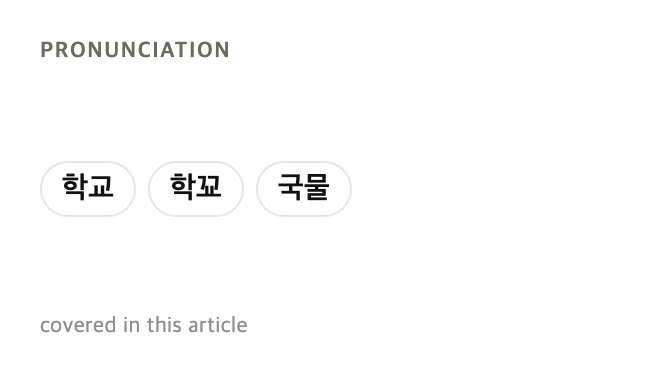
Type 학교 into almost any romanizer and it gives you hakgyo. Say hakgyo out loud to a Korean speaker and you will get a small pause before they work out what you meant. The word is pronounced 학꾜, with a hard, tightened second syllable, and every Korean speaker produces it that way without exception.
The romanization is not broken. It is doing exactly what it was designed to do, and what it was designed to do is not what you assumed. Once you know which sounds it writes and which it silently drops, romanization stops being a trap and becomes a tool with a known blind spot.
Two different jobs on one line of text
A romanization can answer one of two questions. It can tell you how a word is built, or it can tell you how a word arrives in the air. Those two answers are frequently different, and no single line of Latin letters can give you both.
The system used on Korean road signs, passports and most language apps is Revised Romanization, and it mostly answers the first question. It transliterates the standard spelling, with a specific set of sound changes folded in and one large category left out on purpose.
That single design decision is responsible for most of the confusion learners have about romanized Korean. It is also almost never explained, which is why people conclude their own ears are unreliable.
What romanization actually gets right
Start with the good news, because romanization is more faithful than its reputation suggests. Consonant assimilations — the changes where one sound reshapes its neighbour — do get written into the Latin form.
Here is what our own romanizer produces, alongside the pronunciation our engine derives:
| Spelled | Romanized | Actually said |
|---|---|---|
| 국물 | gungmul | 궁물 |
| 신라 | silla | 실라 |
| 대통령 | daetongnyeong | 대통녕 |
| 같이 | gachi | 가치 |
| 좋다 | jota | 조타 |
| 한국어 | hangugeo | 한구거 |
Look at the second column carefully. Nobody would guess gungmul from the letters 국물 alone, yet that is what the romanization prints, because nasal assimilation is inside the system's scope. The same holds for the merged double-l in silla and the fused aspirate in jota.
So romanization is not lazily transliterating letter by letter. It is applying real phonology — just not all of it.
The change it will never write for you
Now the category it leaves out: tensification. When a plain consonant hardens into its tense twin, Revised Romanization writes the plain letter anyway.
| Spelled | Romanized | Actually said |
|---|---|---|
| 학교 | hakgyo | 학꾜 |
| 국수 | guksu | 국쑤 |
| 걱정 | geokjeong | 걱쩡 |
| 극장 | geukjang | 극짱 |
| 기숙사 | gisuksa | 기숙싸 |
| 꽃집 | kkotjip | 꼳찝 |
Every one of those romanizations writes a plain consonant where the mouth produces a tense one. Guksu suggests a soft s. The actual sound is a tight, pressed 국쑤 that English speakers usually hear as emphasis.
This is not an occasional slip in a few odd words. It is a rule of the romanization system itself, applied consistently, in every dictionary entry and on every street sign.
How often it happens, measured
We can put a number on this, because our vocabulary pages carry the standard pronunciation for 9,641 words taken from the National Institute of Korean Language dictionary. That gives us a spelling and a pronunciation for each entry, side by side.
Of those 9,641 words, 3,357 are pronounced differently from how they are spelled. That is roughly one word in three, before we narrow anything down.
Now the specific case. 1,902 words — very close to one in five of the whole set — contain a tense consonant in their pronunciation that does not appear anywhere in their spelling. Their romanization cannot show it, by rule.
Narrow it further to beginner-level nouns, the words a first-year learner meets in week one, and 177 of them hide a tense consonant this way. 학교, 국수 and 극장 are all on that list, and so is most of a school timetable.
Why the system leaves it out on purpose
The omission is deliberate, and the reasoning is defensible once you see the problem it solves. Tensification is largely predictable from the spelling, so writing it would add characters without adding information for anyone who knows the rule.
There is also a stability argument. A romanization that tracked every tense consonant would spell the same root differently depending on what followed it, which makes place names and personal names inconsistent across documents.
Revised Romanization optimises for a stable, reversible map back to Hangul. It is a transport format for the spelling, not a pronunciation guide, and it was never marketed as one.
The trouble is that learners meet romanization long before anyone explains that scope to them. It arrives on menus and album sleeves looking like a pronunciation hint, so people reasonably read it as one and then blame themselves for the mismatch.
The tensing you can predict from the letters
For a large share of cases, you can generate the missing information yourself. When a syllable ends in a stop sound and the next one begins with a plain consonant, that plain consonant tightens.
- 학교 → 학꾜
- 국수 → 국쑤
- 걱정 → 걱쩡
- 낚시 → 낙씨
- 옷장 → 옫짱
Our pronunciation engine produces every one of those from the spelling alone, with no dictionary lookup involved. If a machine can derive it from the letters, so can you, and after a week of noticing it the conversion becomes automatic.
Read the romanization, spot the stop consonant in front of the plain one, and harden it yourself. That single habit fixes a large fraction of the 1,902 words.
The tensing nothing can predict
Then there is the other kind, and this is where honest tools have to admit a limit. Some words tense after ㄹ or inside a compound with no rule to trigger it, and the only way to know is to have been told.
| Spelled | Romanized | Actually said | Rule-derivable? |
|---|---|---|---|
| 가을비 | gaeulbi | 가을삐 | no |
| 글자 | geulja | 글짜 | no |
| 갈색 | galsaek | 갈쌕 | no |
| 결정 | gyeoljeong | 결쩡 | no |
| 결심 | gyeolsim | 결씸 | no |
We ran all five through our own engine. It returns the spelling unchanged for every one of them, because there is no rule to fire — the dictionary is the only source. The pronunciations in that table come from the dictionary field on our vocabulary pages, not from the converter.
This is why a rules-only pronunciation tool and a dictionary-backed one are different products. Our engine agrees with the dictionary on 91% of the 9,641 entries, and the remaining 9% is mostly this category — which is exactly why the word pages carry the looked-up form rather than a generated guess. You can see it on the entry for 가을비 or 글자.
Clusters that lose a letter on the way out
A second, smaller gap works the opposite way. Korean allows two-consonant endings in spelling, but only one of them survives into speech, and romanization follows the spoken result here rather than the written one.
- 닭 → 닥, romanized dak
- 값 → 갑, romanized gap
- 읽다 → 익따, romanized ikda
The romanization of 읽다 is worth a second look. It drops the silent ㄹ, which is the faithful choice, and then writes -da for a syllable that is unmistakably tense in speech. One line of Latin text, two different policies, both applied correctly.
Word boundaries break it too
Romanization is written word by word, but Korean is not spoken that way. A final consonant slides into the next syllable whenever a vowel follows, and that movement crosses the space in the romanized text.
Inside a single word the romanizer handles it cleanly: 한국어 comes out hangugeo, with the ㄱ already moved into the middle. Across a space it cannot, because it does not know what you will say next.
So a romanized phrase gives you correctly spelled chunks that still do not match the continuous stream you hear. This is the same boundary problem covered in why you can read Korean subtitles but can't hear them, seen from the reading side instead of the listening side.
How to read romanization without getting fooled
None of this means you should abandon romanization. It means you should read it with the right expectations, the way you read a map that shows roads but not hills.
- Treat it as a spelling aid, not a pronunciation guide. It tells you which Hangul
letters are there.
- Assume every plain consonant after a stop is tense. Hakgyo is 학꾜, guksu is
국쑤, and the pattern is regular.
- Never trust it after ㄹ. That is where the unpredictable tensing lives, and no
romanization will warn you.
- Check a dictionary form for any new noun. One lookup settles what a hundred
listens will not.
- Stop using it entirely once you can read Hangul. It has a job, and that job ends
in about the third week.
The fastest fix is to see the spelling, the actual sound and the romanization at the same time rather than one at a time. You can paste any Korean line into our pronunciation tool and get all three layers back for it, including the tense consonants the Latin form cannot show.
FAQ
**Is hakgyo or hakkyo the correct romanization?** Hakgyo is correct under Revised Romanization, the official system, and hakkyo is closer to the actual sound. Both are defensible; they answer different questions. Use hakgyo when writing an address and expect 학꾜 when listening.
Does this mean romanization is useless? No, and it is genuinely good at what it covers. It writes assimilation, aspiration and palatalization faithfully, which is most of Korean phonology. Tensification is the one large category it excludes, so once you patch that gap yourself the tool becomes reliable.
Which romanization system shows the real sound? None of the widely used ones do it completely. McCune-Reischauer marks aspiration more visibly, and academic transcriptions can mark tensing, but neither is what apps and signs use. In practice the standard pronunciation written in Hangul is the accurate answer, not a Latin respelling.
**Why does my textbook write sunbae but I hear something harder?** Because you are hearing tensing that the romanization did not print, and it is happening in a lot more words than that one. Roughly one word in five of our 9,641-entry set has a tense consonant its romanization cannot show.
Should I learn the tensing rules or just memorise words? Learn the predictable rule first, since it is one pattern and it covers the majority of cases. Memorise only the ones that resist it, which are mostly compounds and words with ㄹ before the tensed sound.
How do I check a specific word quickly? Look it up rather than guessing, because the unpredictable cases are unpredictable by definition. Every entry on our vocabulary pages carries the standard pronunciation alongside the spelling, and the pronunciation tool accepts a full sentence when you need one converted.
Read next