Why You Can Read Korean Subtitles But Can't Hear Them
· 12 min read
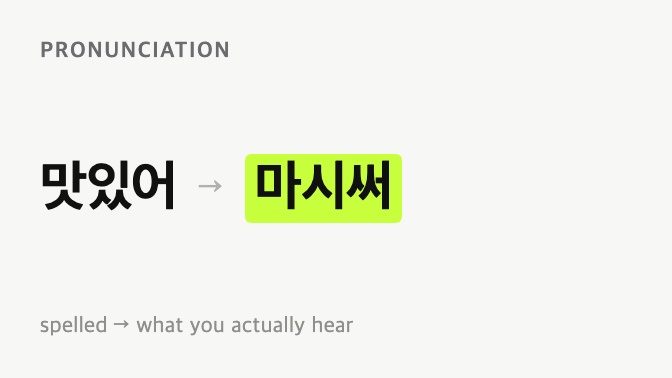
You paused the episode, read the Korean subtitle, and understood every single word on the screen. Then you rewound ten seconds, closed your eyes, and heard almost nothing you recognized. If that has happened to you, you are not bad at listening, and you have not hit some mysterious plateau that only talent gets you past.
You are running into a gap that exists inside the Korean writing system itself. Korean spelling shows you how a word is built from its parts, not how it comes out of a mouth. Between those two things sits a set of sound-change rules that every native speaker applies automatically, every time, without ever being taught them. Learn the rules and the gap closes, usually faster than people expect.
The gap is systematic, not random
English does a small version of this. Nobody actually says "what are you doing" — they say something closer to "whatcha doin." The difference is that English does it inconsistently and casually, while Korean does it by rule, in almost every sentence, including formal ones.
Here is a line you have certainly heard in a K-drama, written the way it is spelled and then the way it is said:
괜찮아 — spelled gwaenchanha, pronounced [괜차나] gwaenchana
The ㅎ did not get dropped because the actor was mumbling. It weakened because ㅎ between vowels always weakens, and the ㄴ underneath it slid forward into the empty slot. A professional news anchor reading the same word in a studio would produce the same sound.
Once you see a handful of these side by side, the pattern stops feeling like sloppiness and starts feeling like arithmetic:
| Spelled | Actually heard | What changed |
|---|---|---|
| 맛있어 | [마시써] | liaison + tensing |
| 어떻게 | [어떠케] | ㅎ fused with ㄱ |
| 같이 | [가치] | ㅌ + 이 became 치 |
| 좋아요 | [조아요] | ㅎ vanished between vowels |
| 잖아 | [자나] | ㅎ vanished, ㄴ slid over |
| 감사합니다 | [감사함니다] | ㅂ became ㅁ before ㄴ |
Look at that last row for a second longer than the others. The most common phrase in the entire language is not pronounced the way it is written, and most beginner courses never mention it. Learners spend months hearing gamsahamnida while reading gamsahapnida and quietly assuming their ears are broken.
Rule 1 — Liaison: the final consonant moves right
This is the rule that causes the most damage, because it does not just change a sound. It moves the boundary between words, which means the shape you are listening for is not the shape that arrives.
When a syllable ends in a consonant and the next syllable begins with a vowel, that final consonant jumps into the next syllable and becomes its opening sound:
- 밥이 → [바비]
- 한국어 → [한구거]
- 음악을 → [으마글]
- 옷을 → [오슬]
You are scanning the audio stream for bap-i, with a clean break in the middle, but what arrives is ba-bi, one smooth unit. The consonant never disappeared — it just moved to the other side of the wall. Subtitles preserve the spelling because that is what spelling is for, so this particular mismatch is guaranteed on every line that contains it.
Liaison is also why counting words by ear feels impossible early on. A three-word phrase can arrive as one continuous run of syllables with no audible seams anywhere.
The good news is that liaison is completely predictable. If you can see the final consonant in the spelling, you already know where it went.
Rule 2 — Tensification: plain consonants harden
After certain stop sounds, the plain consonants ㄱ ㄷ ㅂ ㅅ ㅈ tighten into their tense twins ㄲ ㄸ ㅃ ㅆ ㅉ. Nothing in the written form warns you that this is coming, and the change is not optional.
- 학교 → [학꾜]
- 식당 → [식땅]
- 늦게 → [늗께]
- 입국 → [입꾹]
To an English-speaking ear the tense consonants can sound almost like emphasis, as though the speaker is being firm about something. They are not. It is a purely mechanical consequence of which sounds happen to be neighbors.
Rule 3 — Nasalization: stops become nasals
When a stop consonant runs into a nasal consonant such as ㄴ or ㅁ, the stop gives up and becomes nasal as well. This is the rule behind 감사합니다, and once you know it you start hearing it everywhere.
- 국물 → [궁물]
- 있는 → [인는]
- 합니다 → [함니다]
- 십만 → [심만]
The polite verb ending -습니다 appears in nearly every formal sentence in Korean, which means this single rule is firing constantly in interviews, award speeches, and news broadcasts — exactly the content learners like to practice with.
Rule 4 — Lateralization: ㄴ and ㄹ merge
When ㄴ and ㄹ end up next to each other, the ㄴ surrenders and turns into another ㄹ. The result sounds like a long, liquid double-l that has no obvious relationship to the spelling.
- 신라 → [실라]
- 설날 → [설랄]
- 연락 → [열락]
This one trips people up on names and dates more than on verbs, because place names and holidays are where ㄴ and ㄹ tend to collide.
Rule 5 — Aspiration: ㅎ fuses instead of vanishing
Earlier we saw ㅎ disappear between vowels. When ㅎ meets a stop consonant instead, it does the opposite — it merges with that consonant and turns it into an aspirated one.
- 축하 → [추카]
- 좋다 → [조타]
- 입학 → [이팍]
- 백화점 → [배콰점]
So ㅎ has two completely different behaviors depending on its neighbors, which is why it confuses learners more than any other letter. Between vowels it evaporates. Against a stop it fuses. It is never simply silent.
Rule 6 — Palatalization: ㄷ and ㅌ before 이
When ㄷ or ㅌ is followed by 이, the consonant shifts to ㅈ or ㅊ. This one shows up in a small number of words, but they are frequent words.
- 같이 → [가치]
- 굳이 → [구지]
- 해돋이 → [해도지]
같이 alone is worth memorizing on sight. It appears constantly in casual speech and almost nobody guesses [가치] from the spelling.
Rule 7 — Contraction in casual speech
The first six rules are grammar. This one is simply speed, and it is the reason variety shows feel so much harder than dramas. When Koreans talk fast, they compress:
- 그런데 → 근데
- 그러니까 → 그니까
- 뭐라고 → 뭐래
- 이거는 → 이건
Subtitles frequently print the full form even when the speaker produced the short one, because subtitle editors are working against a reading-speed limit and a legibility standard rather than transcribing phonetics. That is not an error in the subtitle. It is a different job from the one your ear is doing.
Why this hits K-pop fans hardest
Learners who came to Korean through idol content run into these rules earlier and harder than learners who came through textbooks, and the reason is the material itself rather than any difference in ability.
Variety shows and live broadcasts are unscripted, which means the speakers are producing fast conversational Korean with every contraction in Rule 7 fully engaged. Group chat segments layer several people talking over one another, and the on-screen captions that Korean variety adds are edited for comedic emphasis rather than for phonetic accuracy. A caption may bold a word the speaker actually swallowed, or spell out a full form nobody said.
Idol speech also leans heavily on the polite -요 and formal -습니다 endings when addressing fans, which means Rule 3 nasalization is firing on nearly every sentence in a fan meeting or an award speech. If you learned 합니다 as hamnida by ear and then saw it written, you already discovered this rule without knowing its name.
Song lyrics compound everything. Melody stretches vowels, drops final consonants that would normally liaise, and re-times syllables to fit a beat, so the same word can arrive in two different shapes inside one track. This is why fans who follow dialogue comfortably still find lyrics opaque, and why reading a romanized lyric sheet often makes the problem worse rather than better.
The three things learners try that do not work
Listening more without noticing anything. Passive exposure builds familiarity with the general music of the language, and that is genuinely worth something, but it does not build the mapping between a spelling and a sound. Your brain has no reason to encode a rule it has never been asked to name, so hundreds of hours can pass with the same words still arriving unrecognized.
Slowing the playback down. This feels productive because individual syllables become audible, but the sound changes do not reverse at lower speed. 감사합니다 is still [감사함니다] at 0.75x. You end up hearing the same mismatch more clearly rather than resolving it, and you also train your ear on a tempo that never occurs in real speech.
Leaning on romanization. Romanized text is useful in the first week for reading Hangul at all, and it is genuinely necessary for fandom words that entered English by ear. But most romanization systems transcribe the spelling, not the sound, so gamsahapnida reproduces exactly the error you are trying to escape. Romanization that follows pronunciation is far more useful, and far rarer.
Why English subtitles quietly make this worse
An English subtitle hands you the meaning and hides the sound completely. You reach the end of the episode feeling like you followed everything, and in a sense you did, but your ear was never asked to do any work. Nothing was learned about how Korean actually arrives.
A Korean subtitle is a real improvement, because at least the language on screen matches the language in the air. But it still shows you the spelling, and the spelling is precisely the thing that does not match. So learners often experience the frustrating middle state described at the top of this article: full comprehension while reading, near-zero comprehension while listening.
What actually closes the gap is seeing three layers at the same moment — what is written, what is heard, and what it means. The written form teaches you the word. The spoken form trains your ear. The meaning keeps you in the story so you do not quit.
How to practice this on purpose
Most listening advice amounts to "watch more," which is why most people plateau. Volume alone does not build the converter in your head, because your brain has no reason to notice a rule it cannot name. Deliberate practice looks like this instead:
- Pick one line, not one episode. Ten seconds is plenty of material.
- Read the Korean subtitle out loud exactly as it is written, letter by letter.
- Play the audio and listen specifically for the mismatch you just created.
- Name the rule. Was that liaison? Nasalization? This step is the one everyone skips and it is the one that makes the learning stick.
- Repeat the line until you can predict the sound from the spelling before the audio plays.
Five lines a day, done this way, will outrun an episode a week done passively. You are not memorizing vocabulary here. You are building a converter that runs automatically on every future sentence you hear, and converters get built by focused repetition rather than by exposure.
Pick lines with dialogue rather than narration. Conversational speech contains far more of these changes per second.
Keep a short list of the specific words that fooled you. Reviewing that list is more efficient than reviewing the rules in the abstract, because it targets the exact gaps in your own ear.
The shortcut
None of the seven rules require judgment. They are deterministic, which means a machine can apply them for you and show you the result while the line is still on screen.
That is the entire point of a sound-change layer: instead of hunting for the spoken form yourself, you watch the written form and the spoken form sit next to each other, line after line, until your ear starts producing the conversion on its own and you no longer need the crutch.
No general-purpose subtitle tool does this for Korean today — we checked each of them against the same table in Language Reactor alternatives for Korean. And once your ear catches up, the next wall is usually vocabulary that no dictionary carries: the fan words in 66 Korean slang words every K-pop fan runs into.
FAQ
Do I need to memorize all seven rules? No. You need to be able to recognize them when they happen, which is a much lower bar. Recognition builds naturally from seeing written and spoken forms side by side, and almost never from drilling a chart in isolation.
Does this apply to K-pop lyrics too? Yes, and more aggressively. Singers stretch, compress, and re-time syllables on top of the normal rules, and lyric sheets show only the spelling. That combination is why lyrics feel unlearnable at first even to people who handle dialogue fine.
Which rule should I learn first? Liaison, without much competition. It affects more sentences than any other rule and it is the direct cause of the "I can't tell where words end" feeling.
Is this why 감사합니다 sounds like 감사함니다? Exactly that. Rule 3, nasalization: the ㅂ becomes ㅁ because a ㄴ follows it. Every native speaker does this and almost none of them are aware of it.
Do native speakers know these rules? Consciously, usually not. They acquired the conversions as children and apply them without thinking, which is why asking a Korean friend "why did you say it like that?" tends to produce a puzzled look rather than an explanation.
Will learning this fix my listening completely? It fixes one of the two big problems. The other is speed — native conversational Korean is simply fast, and rules you can apply slowly still need practice before they run in real time. Sound change is the part you can study directly, so it is the efficient place to start.
📥 Free download — the one-page sound-change cheat sheet with all seven rules, side by side.
Read next