Language Reactor Alternatives for Korean (2026)
· 11 min read
Language Reactor is the default answer when anyone asks how to watch Netflix with dual subtitles, and two million installs suggest that reputation is deserved. For most languages it is genuinely the right first tool, and for a lot of people it stays the only tool they ever need.
If you are learning Korean specifically, though, there are two problems with it. Neither is a bug that will be patched next month, because neither is really a bug — they are both consequences of what a general-purpose tool is designed to do.
Problem 1 — Korean breaks more often than other languages
Search the Language Reactor forum for Korean and the same thread shape repeats across several years. Subtitles stop loading. Saved vocabulary fails to sync. Users see Failed to retrieve linguistic data: NETWORK_ERROR Lang: ko while the same session handles Italian and Russian without complaint.
The threads follow a recognizable arc: someone reports it, a few people confirm, it gets fixed after a week or two, and then it returns months later. That pattern has held long enough that Korean learners in those threads talk about it as a known seasonal inconvenience rather than an incident.
One user summarized the experience after paying for the upgrade:
"I use language reactor to put korean and english subtitles, now, I pay to only be able to watch with english subtitles… I just feel scammed."
None of this means you should avoid the tool. It does mean you should know what your fallback is before the evening you actually need one, because outages tend to arrive in the middle of a study habit rather than at a convenient planning moment.
Problem 2 — Korean-specific information gets flattened
The deeper issue is structural. A general dual-subtitle tool shows you two lines of text, one in the target language and one in yours. That is sufficient for Spanish, where most of the meaning survives translation. Korean encodes several things in places that an English line physically cannot carry.
| What Korean encodes | What an English subtitle does with it |
|---|---|
| Speech level (반말 / 해요체 / 합쇼체) | Erases it completely |
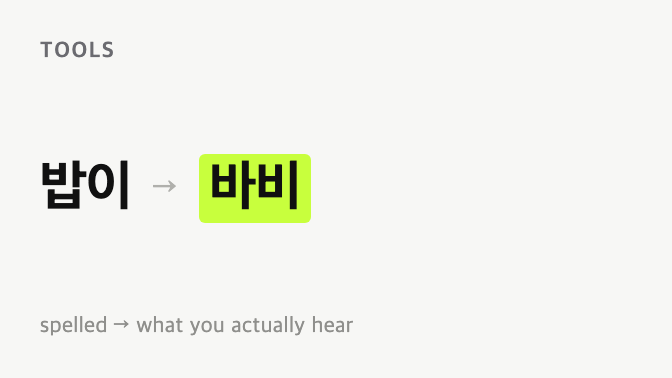
| Sound change (밥이 → [바비]) | Never shows it |
| Irregular conjugation (들으니까 → 듣다) | Hides the dictionary form |
| Fandom slang (입덕, 최애) | Translates literally or drops it |
The speech-level row matters more than it looks. When a character drops from 존댓말 to 반말 mid-scene, that shift is the emotional event — it signals intimacy, contempt, or a decision to stop performing politeness. The English subtitle renders both versions as the same neutral English sentence, so the viewer watching with English subtitles experiences a scene that quietly lost its point.
A concrete example
Say a character has spent six episodes addressing someone as 선배님 with full 합쇼체 endings. In episode seven, alone on a rooftop, he switches to 반말 for one line.
In Korean that single switch carries the whole scene. It says the distance is gone, and a Korean viewer registers it before the sentence finishes.
In English both versions come out as something like "I'll wait for you." Same words, same tone, no signal. A viewer relying on the English line watches a pause and some meaningful lighting, and reasonably concludes that nothing much happened.
This is not a translation failure. English simply has no grammatical slot to put that information in, so a subtitle line cannot carry it no matter how good the translator is. It has to be surfaced somewhere else, and none of the general tools surface it.
The alternatives, honestly compared
Kimchi Reader — the Korean specialist
Best for: intermediate learners who already do sentence mining and can read Hangul comfortably.
Kimchi Reader is Korean-only, and that focus shows everywhere in the product. Its grammar database is public on GitHub and contains 327 grammar points, 403 definitions, 815 examples and 1,165 audio files, which is why the community keeps extending it rather than waiting for the developer. The reader does word-level lemmatization, surfaces Hanja origins for vocabulary that came from Chinese, and ranks words by frequency so you can tell whether something is worth learning at all.
The trade-offs are real. There is no romanization, which is a hard wall if you cannot yet read Hangul at speed — and that describes most people who arrived at Korean through K-pop rather than through a class.
It also needs the content to already carry Korean subtitles, so small YouTube channels are out. Pricing is €12 per month or €99 per year.
The install base is about 3,000, which is small in absolute terms but carries the strongest reputation in the Korean-learning corner of Reddit.
Migaku — the power tool
Best for: people who already run Anki every day and want to industrialize their card creation.
Migaku turns any subtitle line into a media-rich flashcard containing a screenshot, the audio snippet, and the sentence context. It supports more than thirty languages, has a companion mobile app for reviews, and is generally regarded as the most capable option in this category if you are willing to configure it.
That last clause is the trade-off. Reviews consistently describe budgeting a weekend to get everything working the way you want. If you are not already an Anki user, the setup cost lands on your motivation rather than on your calendar, and motivation is the scarce resource in language learning.
Trancy — the AI-forward option
Best for: learners who want pronunciation feedback inside the same tool they watch with.
Trancy pairs dual subtitles with AI word lookup, speaking practice with scoring, and a mobile app, and at roughly 300,000 installs it is the second-largest tool in the category. For people who want one subscription rather than a stack, it covers more ground than anything else on this list.
Because it is general-purpose, the Korean-specific depth is shallow. You get definitions and translations rather than grammar analysis, and none of the four rows in the table above are addressed directly.
Lingopie — the curated library
Best for: people who want zero setup and do not care which shows they watch.
Lingopie brings its own catalog with interactive subtitles and flashcards already built in, so there is no extension to install and nothing to configure. For a certain kind of learner that convenience is worth the subscription by itself.
The catch for Korean learners is specific and easy to miss: as of 2026 the Lingopie Netflix extension covers Spanish, French, Italian and German — not Korean. If you choose Lingopie for Korean you are choosing its internal catalog, not your own Netflix queue. Pricing runs roughly $12–30 per month depending on plan.
Mirinae — the sentence analyzer
Best for: taking one difficult sentence apart down to the last particle.
Paste a Korean sentence into Mirinae and you get parts of speech, particles, honorific markers, conjugation paths, idiom detection, and a phrase-structure parse tree.
The grammar pattern library behind it is built on National Institute of Korean Language standards, which makes it more rigorous than most competitors on the analysis side.
It is not, however, a watching tool. The browser extension is Manifest V2 and declares no content scripts, which means you click the icon to analyze text on a page rather than getting an always-on dual-subtitle layer. It analyzes text; it does not ride along with video. Pricing is $11.99 per month or $44.99 per year.
What to do when Language Reactor breaks
Because the Korean outages are recurring rather than one-off, it is worth having a two-minute recovery plan instead of losing the evening.
First, check whether the failure is Korean-specific by switching the target language to something else on the same video. If Italian loads and Korean does not, the problem is server-side and no amount of reinstalling will help.
Second, keep one fallback already installed. Switching tools takes thirty seconds if the extension is sitting there and twenty minutes if you have to research alternatives while frustrated.
Third, if the content has a Korean subtitle track, almost any of the tools below will run on it. The outage blocks one product, not the underlying subtitle.
Why the Korean-only tools stay small
There is something odd in the install numbers that is worth naming, because it changes how you read every recommendation in this article.
Language Reactor has roughly two million installs. Trancy has about 300,000. Then the numbers fall off a cliff: Kimchi Reader sits around 3,000 and Mirinae around 756, despite Kimchi Reader being the tool most often recommended by serious Korean learners.
Reputation and reach are clearly not the same thing here. The Korean-specific tools are respected by people who study seriously and essentially invisible to everyone else, which is why most learners never hear about them until someone in a thread mentions one.
That gap has a practical implication. If you are choosing a tool, the popular option is popular because it is general, not because it is better at Korean.
Quick comparison
| Korean-only | Romanization | Speech levels | Sound change | Works on any video | Price | |
|---|---|---|---|---|---|---|
| Language Reactor | ✗ | ✗ | ✗ | ✗ | ✓ | Free / paid |
| Kimchi Reader | ✓ | ✗ | partial | ✗ | needs subs | €12/mo |
| Migaku | ✗ | ✓ | ✗ | ✗ | ✓ | paid |
| Trancy | ✗ | ✓ | ✗ | ✗ | ✓ | ~$3.5–5/mo |
| Lingopie | ✗ | ✓ | ✗ | ✗ | own catalog only | ~$12–30/mo |
| Mirinae | ✓ | ✓ | partial | ✗ | click-to-analyze | $11.99/mo |
How to choose
Start from your own constraint rather than from the feature list, because the constraint eliminates most of the options immediately.
If you cannot read Hangul fluently yet, you need romanization, and that rules out Kimchi Reader today no matter how good its grammar database is.
If you already use Anki daily, Migaku will pay back its setup cost within a month. If you want zero setup and do not mind a fixed catalog, Lingopie removes every decision from your evening.
If you mainly want to dissect one hard sentence rather than watch continuously, Mirinae is more precise than anything else here. And if you want dual subtitles on anything at all and accept that the depth will be shallow, staying on Language Reactor is a perfectly reasonable answer.
What none of them do
Look at the comparison table one more time, specifically at the sound-change column. It is empty across every row, and the speech-level column is partial at best.
That emptiness is not an artifact of which tools made this list. It is the actual state of the category in 2026. Every tool here shows you what is written. None of them shows you what is heard, or who the speaker is being polite to, at the moment the line plays — which are precisely the two things a Korean learner watching K-content most needs and least gets.
If the first half of that sentence sounds like your problem, the gap has a name and a small number of rules behind it — we walk through all seven in why you can read Korean subtitles but can't hear them. And if what stops you is the vocabulary rather than the sound, the fan words that captions leave untranslated are collected in 66 Korean slang words every K-pop fan runs into.
FAQ
Is Language Reactor still worth using for Korean? Yes, as a baseline. It is free to start, it works most of the time, and it is the easiest thing to set up. Just do not build your entire routine on it without knowing your fallback.
What do Korean learners on Reddit actually recommend? Two different answers depending on who is asking. For casual K-drama watching, Language Reactor is the usual first suggestion. For serious Korean-only study paired with Anki, Kimchi Reader is the one that keeps coming up, and it is also listed in Refold's learning libraries.
Do any of these work on mobile? Trancy and Lingopie have mobile apps. The browser-extension tools are desktop Chrome only, which is a real limitation given how much K-content gets watched on phones.
Do I need Korean subtitles for these to work? Mostly yes. A tool that overlays subtitles needs a subtitle track to overlay. Korean Netflix originals almost always have one, but smaller YouTube channels and live broadcasts frequently do not.
Can I use more than one at once? Yes, and many people do — for example a watching tool plus a separate analyzer for the sentences that stump them. The main cost is subscription overlap, so it is worth deciding which one is your daily driver before adding a second.
Install counts are Chrome Web Store public figures and pricing is as published, both as of 2026-08-10.
Read next