Korean Speech Levels: The Three You Actually Need
· 10 min read
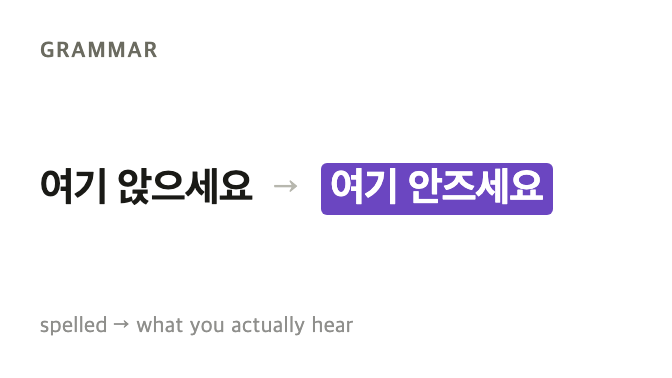
Korean speech levels are the three registers every sentence has to pick between, and the choice sits in the verb ending. Formal, polite, and casual are not optional politeness — they are grammar.
English never asks you to make that decision. Korean asks it every single time, and there is no neutral setting to fall back on.
Grammar books count six or seven levels. Three of them cover almost everything you will hear on screen or say out loud, and the rest are period costume.
여기 앉으세요 · yeogi anjeuseyo · spoken [여기 안즈세요] — polite
Every Korean sentence below was written for this article rather than transcribed from a broadcast. Each one was then run through the engine behind our extension: the level label comes from the parser, and the romanization and bracketed spoken form are generated rather than typed by hand.
The three levels, at a glance
One request, built three ways. The meaning does not move. Only the ending does.
| Level | Korean name | "Wait a moment" | Romanization | Where it belongs |
|---|---|---|---|---|
| Formal | 하십시오체 (hasipsioche) | 잠시만 기다려 주십시오 | jamsiman gidaryeo jusipsio | Announcements, service counters, the stiff end of an office |
| Polite | 해요체 (haeyoche) | 잠시만 기다려요 | jamsiman gidaryeoyo | Nearly every conversation between adults |
| Casual | 해체 (haeche), everyday name 반말 (banmal) | 잠시만 기다려 | jamsiman gidaryeo | Friends, family, anyone younger or junior |
The casual form is the shortest thing Korean can say: a stem and an ending, nothing else. Polite takes that same form and adds 요 to the end of it.
Formal does not build on either. It swaps the ending set out entirely, which is why it is the one that looks least like its two neighbors.
The level is chosen fresh in every sentence rather than fixed once per relationship. Two people can hold a whole conversation at one level and then move, and the move is what carries the news.
Formal: 하십시오체
You will hear this level for years before you have any real reason to produce it. It belongs to train announcements, ticket windows, news anchors, and meetings with an agenda.
The markers are easy to spot, because there are only three worth memorizing: 습니다 for statements, 습니까 for questions, 십시오 for requests.
지금부터 회의를 시작하겠습니다 · jigeumbuteo hoeuireul sijakagetseumnida · spoken [지금부터 회의를 시자카겓씀니다] — formal
어떻게 오셨습니까 · eotteoke osyeotseumnikka · spoken [어떠케 오셛씀니까] — formal
열차가 잠시 후 도착합니다 · yeolchaga jamsi hu dochakamnida · spoken [열차가 잠시 후 도차캄니다] — formal
Look at the gap between the spelling and the bracketed sound. The ㅂ in 습니다 and 합니다 is never actually pronounced as a ㅂ, because the ㄴ behind it pulls the sound over to ㅁ.
That single change is responsible for a surprising amount of "I could read the subtitle but heard nothing." The most formal register in the language is also one of the least phonetically obvious.
There are occasions when a learner has to produce it. A job interview, a presentation to a room, and any customer-facing job all run on this level from the opening line.
Polite: 해요체
If you learn one level first, learn this one. It is the default between adults who are not close, and it is what a stranger will use with you before anything else about the relationship is established.
The marker is a 요 at the very end of the sentence, and that is very nearly the whole rule.
오늘 진짜 피곤하네요 · oneul jinjja pigonhaneyo · spoken [오늘 진짜 피곤하네요] — polite
이거 얼마예요 · igeo eolmayeyo · spoken [이거 얼마예요] — polite
정말 맛있죠 · jeongmal masitjyo · spoken [정말 마싣쬬] — polite
The third one is worth flagging early. 죠 is 지요 squeezed into one syllable, the 요 is still in there, and the sentence is fully polite even though the ending does not look like it.
Politeness in 해요체 also leaves room to be warm, which is why it dominates ordinary speech. It is difficult to sound friendly in 하십시오체 and effortless in 해요체.
Casual: 해체, better known as 반말
Casual speech is the level you will understand first and should produce last. Subtitled drama is saturated with it, because most relationships on screen are close ones.
There is nothing added on to look for. What defines this level is the absence of the other two: the sentence simply stops.
어제 그 영화 봤어 · eoje geu yeonghwa bwasseo · spoken [어제 그 영화 봐써] — casual
너 지금 어디야 · neo jigeum eodiya · spoken [너 지금 어디야] — casual
우리 이제 그만 가자 · uri ije geuman gaja · spoken [우리 이제 그만 가자] — casual
밥은 먹고 다니냐 · babeun meokgo daninya · spoken [바븐 먹꼬 다니냐] — casual
The last two endings are filed under 해라체 in most grammars rather than 해체: 자 for suggestions, 냐 for blunt questions. For the purpose of hearing where a speaker has placed themselves, the two behave as one band, and our engine labels them together.
반말 vs 존댓말, the pair everyone searches for
Search results usually present Korean as a two-way split, and that split is real. It is simply a coarser cut of the same information.
- 존댓말 (jondaenmal) is the umbrella term for speech that raises the listener. Both the polite and the formal level sit inside it.
- 반말 (banmal) is everything that does not raise the listener, which in practice means the casual level.
The two-way version is enough to tell politeness from intimacy. It is not enough to tell a public announcement from a friendly exchange with a stranger, and those are very different rooms to be standing in.
Speech level is not the same as honorifics
This is the distinction that catches learners who already have the endings straight. Korean marks two separate things, and only one of them is speech level.
Speech level raises the listener, through the final ending. Subject honorifics raise whoever the sentence is about, through an infix 시 and a small set of special nouns and verbs. The two systems run independently of each other.
대표님께서 곧 오십니다 · daepyonimkkeseo got osimnida · spoken [대표님께서 곧 오심니다] — formal
혹시 예약하신 성함을 여쭤봐도 될까요 · hoksi yeyakasin seonghameul yeojjwobwado doelkkayo · spoken [혹씨 예야카신 성하믈 여쭤봐도 될까요] — polite
The second sentence is loaded with deference. 성함 is the elevated word for "name" and 여쭤보다 the elevated word for "ask", yet the speech level is only polite, because the final ending is 요.
주문하신 음료 나오셨습니다 · jumunhasin eumnyo naosyeotseumnida · spoken [주문하신 음뇨 나오셛씀니다] — formal
That last one attaches the honorific 시 to a drink rather than to a person. You will hear it across Korean cafés and shops, usage guides consistently call it an error, and our engine still labels the sentence formal.
That is the right answer, oddly enough. The speech level and the misplaced honorific are separate machinery, and only one of them went wrong.
The sentences that have no speech level
Plenty of real lines never choose a level, and a tool that guesses one anyway is teaching you something false.
아니 그게 아니라 · ani geuge anira · spoken [아니 그게 아니라] — no level
오늘 회의는 세 시 · oneul hoeuineun se si · spoken [오늘 회의는 세 시] — no level
헐 대박 · heol daebak · spoken [헐 대박] — no level
The first stops mid-clause and waits for a sentence that has not arrived yet. The second ends on a noun with the verb dropped, which is extremely common in speech. The third is an interjection plus a noun with no verb anywhere in it.
Our parser returns nothing for all three, deliberately. A confident wrong label is worse than a missing one, because a learner will go ahead and believe it.
The levels in old textbooks that you will not hear
Traditional descriptions of Korean list six or seven levels. Two of the extras are still in circulation, and neither one is aimed at you.
어서 오시오 · eoseo osio · spoken [어서 오시오] — 하오체, outside the modern three
이보게 자네 이리 오게 · iboge jane iri oge · spoken [이보게 자네 이리 오게] — 하게체, outside the modern three
These belong to historical drama, older fiction, and the occasional joke between friends. We map them to nothing rather than forcing them onto the modern scale, because they genuinely do not sit anywhere on it.
One more case deserves its own note. The plain style of books, newspapers, and narration is 해라체, and it turns up in writing constantly.
그는 아무 말도 하지 않았다 · geuneun amu maldo haji anatda · spoken [그는 아무 말도 하지 아낟따] — casual
On a page it is not rudeness at all; it is simply the unmarked style of prose. Said to somebody's face, the same endings are casual, which is why the label lands where it does.
How to read a line for its level in one pass
Look at the last two or three syllables and nothing else. The ending is where the entire social calculation is stored, and the rest of the sentence has almost no vote in it.
- 습니다, 습니까, 십시오 at the end → formal
- a final 요, or 죠 → polite
- anything else that genuinely finishes the sentence → casual
- nothing that finishes the sentence → no level, so skip the line
Two warnings come with that list. The first is that a final 요 is not always the same piece of grammar underneath, and a tool that matches on the character alone will get it wrong.
Our own parser tags a sentence-final 요 differently depending on the word it lands on, and in 저기요 it vanishes into the interjection entirely. That is why the engine checks the surrounding shape of the sentence rather than trusting the tag by itself.
저기 잠깐만요 · jeogi jamkkanmanyo · spoken [저기 잠깐마뇨] — polite
The second warning is about movement. Speakers switch levels mid-conversation, and the switch is always the interesting moment; we read one scene line by line in what English subtitles delete from a Netflix trailer.
FAQ
What are the Korean speech levels?
They are the grammatical registers a Korean sentence must choose between, encoded in the verb ending. Modern speech uses three of them: 하십시오체 formal, 해요체 polite, and 해체 casual. Every finished sentence carries exactly one, and there is no neutral option available.
How many speech levels does Korean have?
Traditional grammars list six or seven, but only three are in general use today. 하오체 and 하게체 survive in historical drama and older fiction. 해라체 is very much alive as the plain written style of prose, and behaves as casual when it is spoken.
Is 반말 rude?
It depends entirely on the relationship, not on the words. Between friends of the same age it is the normal and expected register, and insisting on polite forms there reads as cold. Aimed at a stranger or someone senior it is an insult, and the insult sits in the grammar rather than in anything said.
What is the difference between 해요체 and 하십시오체?
Both raise the listener, so both count as 존댓말, and neither is more "correct" than the other. The polite level is warm and general-purpose, and it is what you will use with almost everyone. The formal level is institutional, and it signals a role rather than a relationship.
Which speech level should a learner use?
Learn the polite level first and use it by default with any adult. It is acceptable almost everywhere, it will never offend anyone, and being slightly too polite costs you nothing. Casual speech is worth understanding immediately and worth producing only once somebody invites you to.
Are 존댓말 and honorifics the same thing?
No, and conflating them causes real errors. 존댓말 raises the person you are speaking to, through the sentence-final ending. Subject honorifics raise the person the sentence is about, through the infix 시 and a set of elevated words, and they can appear in a sentence at any level.
Example sentences on this page were written for this article, not transcribed from any broadcast or subtitle file. Speech-level labels were computed by the same parser our extension uses, and the romanization and bracketed spoken forms were generated by the same pronunciation engine, so what you see here is what the product would show you.
Read next